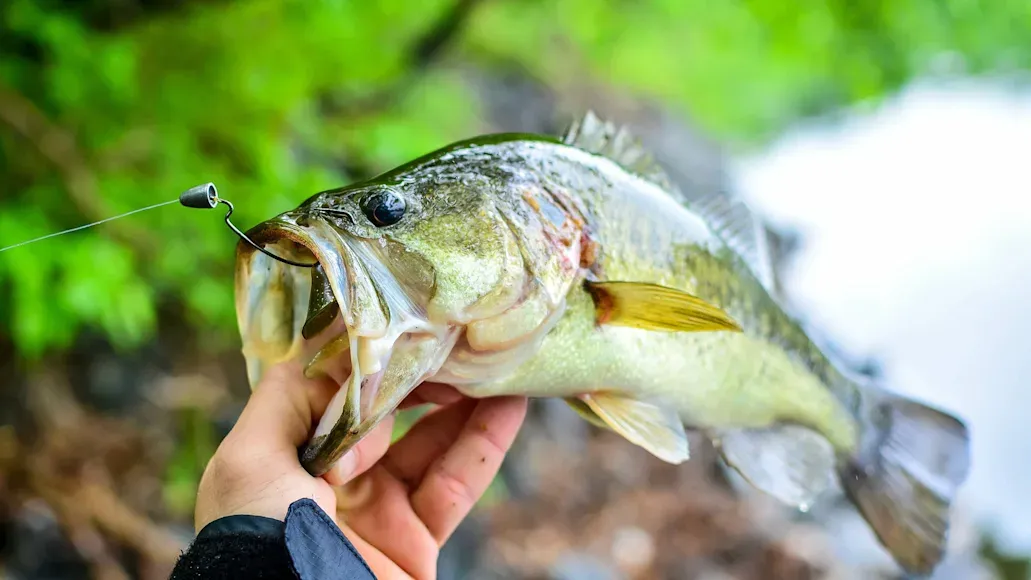
Field feature
Swimbait Hooks: Why Bigger Isn't Always Better
When you buy a massive 6-inch soft plastic swimbait, your instinct is to pair it with the largest, heaviest hook you can find. Here is why that approach kills the action and costs you fish.
Throwing large, hollow-belly or solid-body soft plastic swimbaits (in the 5 to 7-inch range) is one of the most exciting ways to target trophy bass.
When most anglers buy a pack of these massive plastics, they immediately reach for the largest, thickest, heaviest belly-weighted EWG (Extra Wide Gap) hook on the tackle wall—usually a massive 8/0 or 10/0 meat hook with a huge chunk of lead on the keel.
While a giant bait certainly requires a substantial hook, “maxing out” your hook size and wire gauge is a critical mistake that destroys the delicate action of the swimbait and leads to terrible hookup ratios.
1. The “Spine” Effect
A soft plastic swimbait creates its swimming action through flexibility. As water flows over the lure, the body rolls side-to-side (the “belly roll”), and the tail kicks back and forth.
When you thread a massive 10/0 hook through a 6-inch bait, the long metal shank of the hook acts like an inflexible steel spine running through 80% of the bait’s body.
By stiffening the entire midsection of the plastic, you completely kill the seductive belly roll. The bait will swim rigidly, with only the very tip of the tail kicking. To a large, highly educated bass, a stiff, robotic swimbait is an immediate red flag.
The Fix: Downsize the hook shank. If you are throwing a 6-inch bait, a 6/0 or 7/0 hook is usually perfect. You want the hook to exit the belly of the bait in the front half of the lure, leaving the entire rear half completely free of metal so it can flex and swim naturally.
2. The Weight Ratio (Killing the Kick)
Many heavy-duty swimbait hooks come with massive 3/8 oz or 1/2 oz lead weights molded onto the belly.
While heavy weights are necessary for fishing deep water, putting a massive chunk of lead on the belly of the bait completely alters its center of gravity. It acts like a massive anchor. While it keeps the bait running upright, it totally eliminates the side-to-side “hunting” action and the belly roll. The bait just plows straight through the water like a submarine.
The Fix: Use the lightest belly weight you can possibly get away with for the depth you are fishing. If you are fishing in 5 feet of water, a 1/16 oz or 1/8 oz weight is plenty. The lighter weight allows the bait to roll and flash its sides naturally, which is what triggers strikes.
3. The Thick Wire Hookup Problem
Trophy hunters love thick-gauge, heavy-wire hooks because they won’t bend out.
But here is the physics problem: The thicker the wire of the hook, the more force is required to drive the point through the plastic bait AND into the tough, bony jaw of a bass.
When a bass eats a hollow-belly swimbait, you have to compress a massive wad of plastic and drive a thick piece of steel home. If you are using a 10/0 extra-heavy wire hook, you need an insanely stiff rod and perfect leverage to penetrate the jaw. Most anglers simply don’t generate enough force, leading to fish spitting the bait at the boat.
The Fix: Unless you are fishing with 65-pound braided line and an Extra-Heavy flipping stick, opt for a standard-wire hook rather than a heavy-wire hook. A standard-wire 6/0 hook will easily penetrate the plastic and the fish’s mouth with a normal, sweeping hookset on fluorocarbon line.
Bottom Line: Stop building stiff, unnatural Frankenstein baits. Use a hook that is just big enough to secure the nose and the belly, keep the weight light, and let the soft plastic do the swimming. The more freedom the bait has, the more bites you will get.
Related reading
Gear
Best Spinning Reel for Bass Fishing Beginners: The Unfiltered Truth
Forget the marketing hype and spec sheets. Here is exactly what matters when choosing a spinning reel for bass fishing, from a veteran bank angler’s perspective.
Gear
Buzzbait Modifications: Stop Fishing It Straight Out of the Box
A stock buzzbait catches fish, but a modified buzzbait catches monsters. Learn how to tune your topwater prop bait to produce the loudest, most obnoxious squeak possible.
Tactics
Deep Cranking: If You're Not Deflecting Off Cover, You're Not Fishing
Throwing a deep diving crankbait into open water and just reeling it back is taking your lure for a walk. The real violence happens the split second your crankbait smashes into a rock or stump.
评论系统预留位
这里已经为 Giscus 留好位置。等你创建 GitHub Discussions 后,把本组件中的仓库参数改掉,并把 enabled 改成 true 即可启用。